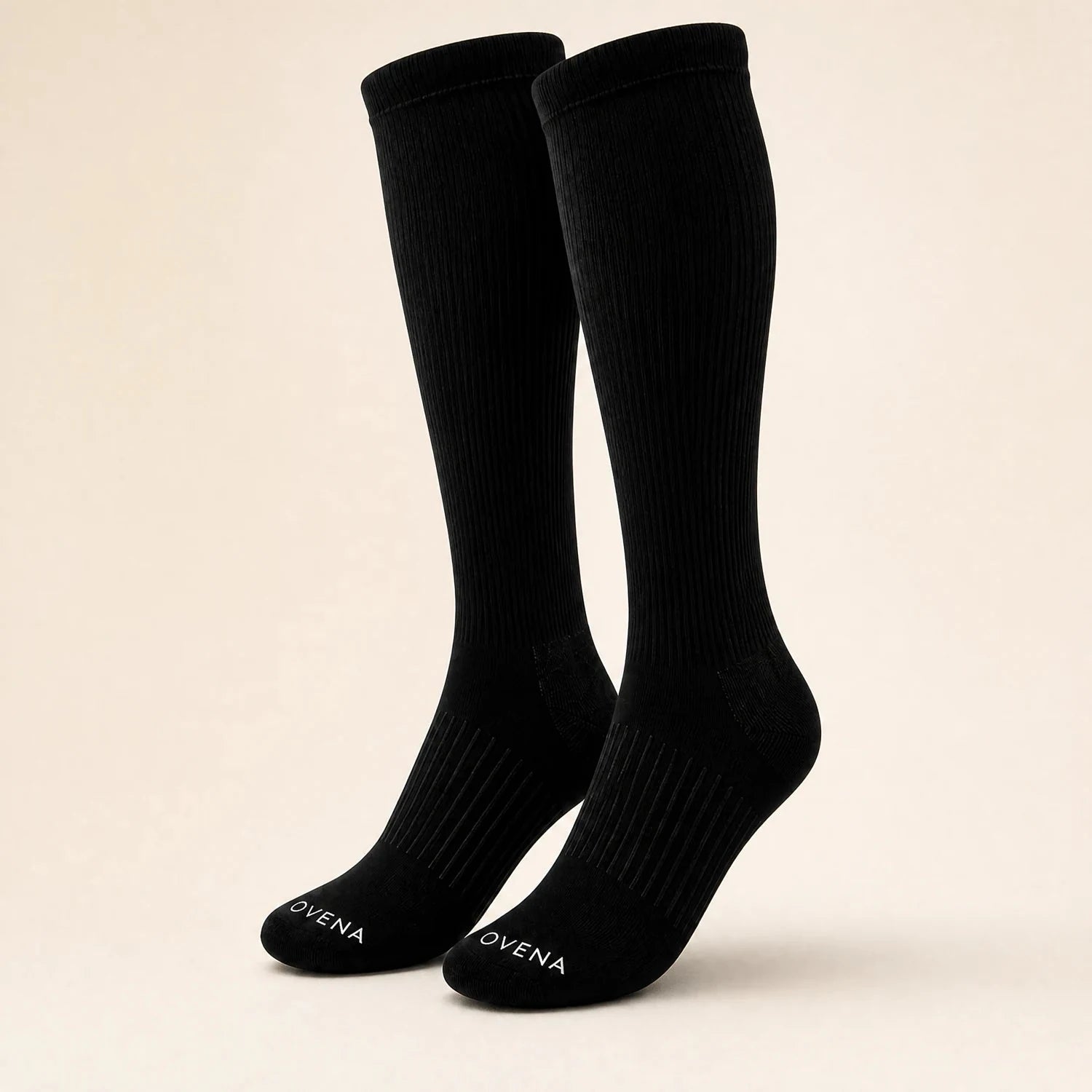
Best compression socks for flying, Cochrane-backed guide
Why graduated compression reduces asymptomatic DVT risk on long flights, what mmHg to choose, when to put them on, and who has elevated risk.
 Reviewed byDr. David Chahine, MD
In this guide
Why flying causes DVT
Three things happen on long flights that elevate clot risk:
- Immobility. When your calf muscles aren't contracting, the venous "muscle pump" that normally pushes blood back up to your heart stops. Blood pools in the lower legs. Pooled blood is more prone to clot formation.
- Hypobaric, low-humidity cabin. Cabin pressure equivalent to 6,000–8,000 ft altitude reduces blood oxygenation modestly. Low humidity dehydrates you. Both contribute to hemoconcentration, thicker, stickier blood.
- Cramped seating. Edge of the seat pressing against the back of the knee can occlude venous return.
The result: by hour 4 of a long flight, you have pooled blood in increasingly hypoxic, dehydrated, concentrated form. Most people pass this risk through with no consequence. Some don't. The clinical name for the event is "traveler's thrombosis" or "economy class syndrome," and the actual incidence in healthy travelers on flights >8 hours runs roughly 1 in 4,000–6,000 (1).
What the Cochrane evidence actually says
The most-cited evidence on flight compression is the Cochrane Review by Clarke et al., which pooled 11 randomized controlled trials of 2,906 long-distance travelers (2). The headline finding:
What the review also showed:
- No participants in the compression group developed symptomatic DVT or pulmonary embolism (vs ~1% in control groups across studies).
- Effect was consistent across studies, strong evidence quality grade.
- Compression also reduced lower-extremity edema and discomfort substantially.
The major caveat: "asymptomatic DVT" means clots detected on ultrasound that didn't cause symptoms. The clinical significance of preventing these vs. the rarer symptomatic events is debated. But virtually every aviation medical society and most national health bodies now recommend compression for high-risk travelers on long flights, and for all travelers on flights over 8 hours.
Who needs compression on flights
Universal recommendation for any traveler on a flight >8 hours.
Strong recommendation even on shorter flights (4–8 hours) if any of:
- Personal or family history of DVT or pulmonary embolism
- Active cancer or chemotherapy
- Recent major surgery (within 3 months), especially orthopedic
- Pregnancy or recent childbirth (within 6 weeks)
- Estrogen-containing oral contraceptive or hormone replacement therapy
- Known hereditary thrombophilia (Factor V Leiden, prothrombin G20210A, etc.)
- Obesity (BMI >30)
- Age >60
- Varicose veins or chronic venous insufficiency
- Lower-extremity injury or cast within the past 3 months
If you have any two or more of these, talk to your doctor about whether prophylactic anticoagulation (low-molecular-weight heparin shot before the flight) is appropriate in addition to compression.
What mmHg to wear
For flying, the right class is 15-20 mmHg or 20-30 mmHg.
- 15-20 mmHg is sufficient for most healthy travelers on flights up to ~10 hours. Easier to put on, comfortable for sleeping in mid-flight.
- 20-30 mmHg is the better choice for travelers with any of the risk factors above, flights over 10 hours, or anyone who's previously had ankle swelling that bothered them. This is also the class used in most of the Cochrane review studies.
Higher classes (30-40 mmHg) are typically not used for flying, they're for chronic venous insufficiency, lymphedema, and post-DVT secondary prevention. Too restrictive for travel.
When to put them on (and take off)
- Put them on before leaving home, before your legs have any chance to swell from sitting in a car, on a train, or at the gate.
- Keep them on through the entire trip, flight, layovers, and any onward car travel.
- Take them off at your destination once you've walked around for an hour or so. The risk window extends ~24 hours after the flight, so if you're going from airport to hotel to bed without much walking, keep them on overnight.
- Don't sleep in compression overnight regularly, for sustained nighttime wear (multiple nights), see a clinician first. Just for the destination-night, it's fine.
What else helps (and what's marketing)
Actually helps
- Hydration, water before and during flight reduces hemoconcentration.
- Skip alcohol on the flight, it's a diuretic and worsens dehydration.
- Walk the aisle every 1–2 hours if you can. Calf-muscle contractions push pooled blood out.
- Ankle pumps in your seat, flex and point your toes 10–15 times every 30 minutes. Works the calf muscle pump while seated.
- Aisle seat for ease of getting up.
Mostly marketing
- "Anti-clot" supplements sold for travel (garlic, vitamin E, etc.), no robust evidence.
- Aspirin "just before flying", for low-risk travelers, evidence doesn't support routine aspirin for DVT prevention. Discuss with your doctor.
- "Anti-DVT inflatable cushions", most haven't been studied. Compression socks are the evidence-based intervention.
Red flags during and after a flight
- Persistent calf or thigh pain, especially one-sided, deep, or worse with flexion
- Unilateral leg swelling (one leg noticeably larger than the other)
- Warmth, redness, or visible vein prominence in one calf
- Shortness of breath, chest pain, or coughing up blood, possible pulmonary embolism, go to the emergency department immediately
20-30 mmHg compression for travel
Ovena's 20-30 mmHg knee-high graduated compression, same regulatory class as the brands airlines stock at $80+. Free shipping over $75.
Shop compression socks →Frequently asked questions
How long does a flight need to be to warrant compression?
What about during the entire trip, not just the flight?
Will they really prevent a DVT?
What about the small fold-up TSA-friendly ones?
Sources
- Watson HG, Baglin TP. Guidelines on travel-related venous thrombosis. Br J Haematol. 2011;152(1):31-34.
- Clarke MJ, Broderick C, Hopewell S, Juszczak E, Eisinga A. Compression stockings for preventing deep vein thrombosis in airline passengers. Cochrane Database of Systematic Reviews 2021, Issue 4. CD004002.
- American College of Chest Physicians (ACCP) Antithrombotic Therapy Guidelines, 2023 update.