Hydrocolloid for surface acne
How hydrocolloid helps protect surface acne spots, what it can and cannot do, and when a cut-to-size roll makes more sense than small pre-cut patches.
 Reviewed byDr. David Chahine, MD
In this guide
What a hydrocolloid patch actually does
Hydrocolloid acne patches work the same way as the medical-grade hydrocolloid wound dressings used in hospitals for blisters, abrasions, and post-procedure skin: the material is a gel-forming polymer that absorbs fluid through an open or broken skin surface. When you place one over a whitehead that has a surface opening, it gently draws out the fluid — oil, pus, and lymph — and holds it in the dressing, turning the patch white or opaque as it fills.
At the same time, the patch acts as a physical barrier. It keeps fingers, nails, and environmental bacteria away from the spot, which is often the most underappreciated benefit. Many breakouts worsen not from the original blockage but from repeated touching and re-contamination.
The patch also creates a slightly moist, protected microenvironment at the skin surface. Many people notice the blemish looks flatter and less red the morning after wearing one overnight, though individual results vary.
Which pimples it works on — and which it doesn't
A hydrocolloid patch is most useful on surface whiteheads and open pimples — blemishes that have come to a head with an open or broken surface. These are the lesions that have something for the dressing to absorb.
It is not appropriate for:
- Cystic acne. Cysts are deep, closed nodules under the skin. There is no surface opening and nothing for the dressing to absorb. A patch sitting on top will not reach the lesion.
- Deep or under-the-skin pimples. Closed comedones, papules, and nodules have no open surface. The patch may provide a small physical reminder not to touch, but it generally offers no absorptive benefit.
- Blackheads (open comedones). The pore is open, but a hydrocolloid patch is not designed to extract plugged sebum. Different tools and approaches are used for blackheads.
If you are unsure what type of acne you have, a dermatologist or primary care provider can help identify the lesion type and recommend the right approach.
Cut-to-size roll vs. pre-cut dot patches
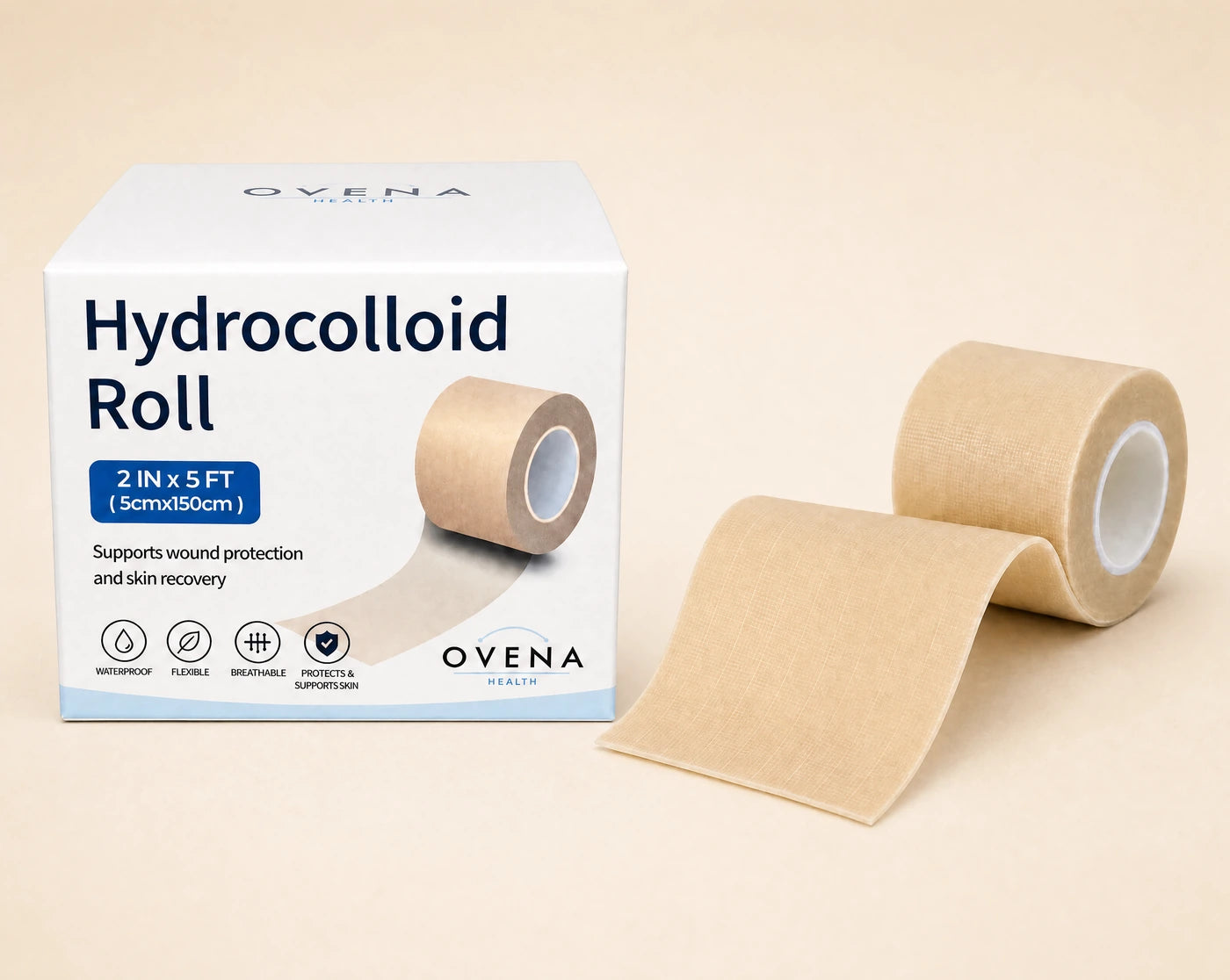
Most "pimple patches" sold in drugstores are tiny pre-cut circles in a limited number of sizes, typically 6–12 mm. A medical-grade hydrocolloid roll — like the Ovena Hydrocolloid Roll — is the same material in a continuous sheet you cut to exactly the size and shape you need.
There are a few practical advantages to cutting your own:
- Custom sizing. A blemish along the jawline, near the nose, or on an unusual contour may not map neatly onto a standard dot. Cutting a patch to fit the specific spot means better contact and better protection.
- Coverage for larger spots. A large or clustered breakout area may need a patch wider than any pre-cut dot. A roll lets you cut a piece to cover the full area without overlapping multiple dots.
- Value. Per square centimeter of dressing, a roll is generally more cost-effective than branded single-use dots.
The material and mechanism are the same either way. The choice comes down to convenience versus flexibility.
How to use one correctly
For best results, follow these steps:
- Cleanse and fully dry the skin. Wash your face with a gentle cleanser and pat dry. The patch will not adhere well to damp or oily skin. Wait a few minutes after washing to ensure the skin is completely dry before applying.
- Apply the patch directly to the surface lesion. Press down gently and hold for a few seconds to ensure contact. Smooth any lifted edges.
- Leave it on. Overnight wear is common. Avoid peeling the patch off prematurely to check it — frequent removal reduces the absorptive effect and can irritate the skin.
- Replace when saturated. When the patch turns opaque or white and feels full, it has absorbed what it can. Remove it, cleanse the skin again if needed, and apply a fresh patch if the spot still has a surface opening.
What a patch cannot do
Being clear about the limits of this approach matters, especially because the term "pimple patch" is sometimes marketed with broad language.
- A hydrocolloid patch contains no medication or active ingredients. It is a physical dressing. It does not treat acne as a condition, does not affect future breakouts, and does not address the underlying causes of acne such as excess sebum production, bacterial colonization, or hormonal factors.
- It does not work on closed or deep lesions. If a patch sits on a closed papule or nodule and turns white, that is condensation from normal skin moisture, not absorption from the blemish.
- It is not a substitute for a dermatologist-directed regimen in anyone with moderate or severe acne, persistent breakouts, or acne that is causing scarring.
When to see a dermatologist
- You have cystic, nodular, or deep acne — hydrocolloid patches are not appropriate and prescription treatments may be needed
- Your acne is persistent and not responding to over-the-counter approaches
- Breakouts are spreading, worsening, or appear to be leaving marks or scars
- A blemish shows signs that may suggest skin infection: spreading redness, increasing warmth, significant swelling, or fever
- You are uncertain whether what you have is acne or another skin condition
Shop the Ovena Hydrocolloid Roll
Medical-grade hydrocolloid in a cut-to-size roll. Cut patches to exactly the shape and size you need — whether for a surface blemish, a blister, or a minor abrasion.
Shop the Ovena Hydrocolloid Roll →