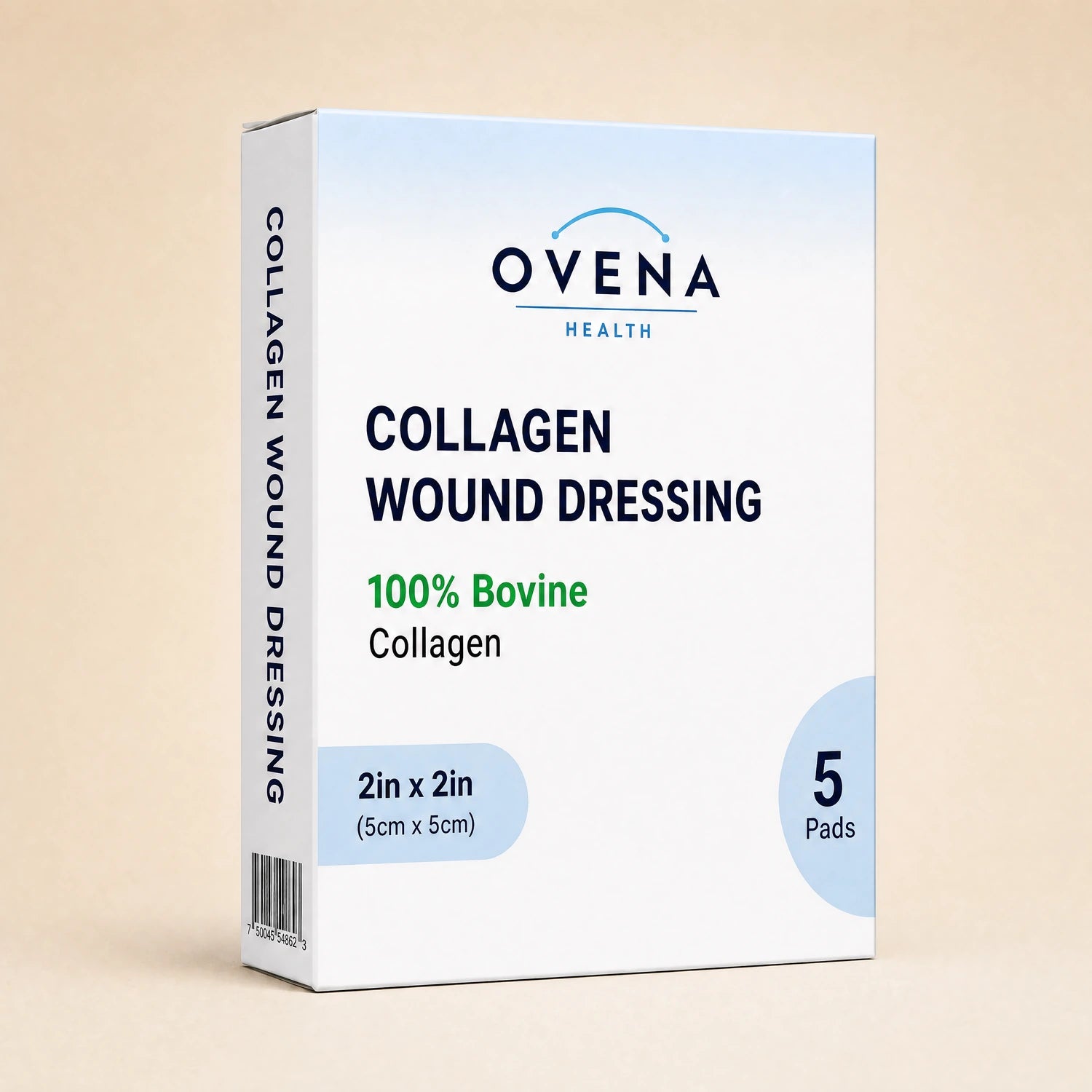
Collagen wound dressing for diabetic foot ulcer
Why diabetic foot ulcers stay stuck and how collagen addresses the specific biochemistry, plus the home care protocol, offloading, and glycemic control needed for healing.
 Reviewed byDr. David Chahine, MD
In this guide
Why diabetic foot ulcers stay stuck
Diabetic foot ulcers (DFUs) are the leading cause of non-traumatic lower-limb amputation in the United States (1). Roughly 15% of people with diabetes will develop a foot ulcer in their lifetime, and a quarter of those will progress to amputation if the wound doesn't heal. Healing DFUs is one of the highest-stakes problems in outpatient medicine, and the reason they're so hard to heal is biochemistry, not technique.
A DFU stays open for three reasons that compound:
- Persistent inflammation from hyperglycemia. High blood sugar drives chronic low-grade inflammation throughout the body. In the wound bed, this means inflammation never resolves, neutrophils and macrophages stay too long, producing damaging enzymes long past their useful purpose.
- Elevated matrix metalloproteinases (MMPs). MMPs are the enzymes responsible for tissue remodeling. In a normally healing wound they spike during inflammation and then drop. In a DFU they stay elevated, concentrations of MMP-9 in chronic DFU fluid run roughly 60× higher than in acute healing wounds (2). They degrade the new collagen the body is trying to lay down, so the wound never accumulates enough tissue to close. More on MMPs here.
- Compromised perfusion and neuropathy. Diabetes damages small blood vessels (microangiopathy) and nerves. Less oxygen reaches the wound bed, less sensation means continued pressure on the ulcer, and immune cells don't traffic in well. The wound doesn't get the resources it needs.
Standard saline gauze does nothing to address any of these. It just covers the wound. That's why so many DFUs sit at the same size for months under "conservative" gauze care.
How collagen dressings address the DFU problem
A collagen wound dressing is a sterile sheet (or powder) of purified Type I bovine collagen, the same protein your body uses to build new skin scaffold. When you place it on a DFU, two things happen simultaneously:
- Sacrificial substrate. The MMPs in the wound bed degrade the dressing's collagen instead of your patient's new tissue. The dressing soaks up the enzyme load. This is the part that addresses the core DFU problem.
- Scaffold for granulation. The remaining collagen matrix gives fibroblasts, capillaries, and new tissue something physical to attach to and grow through. New granulation tissue often appears within 1–2 weeks of starting collagen on a previously stalled DFU.
The collagen is gradually absorbed as the wound heals. There's no peel-off, old dressing comes off as a partial gel at the next change. Full application protocol here.
This is why collagen is on the standard-of-care list for DFUs from WOCN, AAWC, and IWGDF (3), not because it's a new innovation, but because it's the dressing class that directly addresses the MMP biochemistry that makes DFUs stuck.
Clinical evidence
The most-cited evidence is the Veves et al. 2002 RCT comparing Promogran (an ORC+collagen combination) to standard moist wound care in 276 patients with DFUs. The collagen arm showed higher complete healing rates (37% vs 28% at 12 weeks) and significantly shorter time-to-closure (4). Subsequent trials on standalone collagen dressings have shown similar trends, and the WOCN 2022 lower-extremity neuropathic disease guideline lists collagen as a recommended advanced dressing for DFUs that haven't responded to standard care after 2–4 weeks.
What this means in plain language: collagen dressings are not a miracle. Roughly 30–40% of DFUs still won't heal with conservative care alone and will need advanced therapy (negative pressure wound therapy, hyperbaric oxygen, skin substitutes). But collagen is the right tool to start with for the majority of DFUs that do respond to standard care, and it's the dressing class with the strongest mechanistic and clinical case for DFUs specifically.
The home care protocol
The standard protocol your wound care nurse will hand you. Adapt to whatever your specific clinician prescribes.
- Wash your hands with soap and water. Put on clean nitrile gloves.
- Inspect the foot end-to-end. Look at the wound, the surrounding skin, the entire foot top-and-bottom, between the toes, the heel. DFU patients miss new injuries because of neuropathy, that's why daily inspection is non-negotiable.
- Irrigate the wound with sterile saline. Squeeze the bottle to flush, don't just dab. Never use hydrogen peroxide, alcohol, or iodine.
- Pat the surrounding skin dry. The wound bed stays slightly moist.
- Apply the collagen sheet trimmed to the wound size (about 0.25" overlap). For deep, undermining, or tunneling wounds, use collagen powder instead of a sheet.
- Cover with a non-adherent secondary dressing (a foam works well for DFUs with moderate drainage), secure with hypoallergenic tape or a wrap.
- Put the offloading device back on (cast walker, postoperative shoe, total contact cast). Walking on the foot without offloading undoes everything you just did.
- Change every 1–3 days. Closer to every day for high-drainage; closer to every 3 for quiet, low-drainage wounds.
The other half: offloading and glycemic control
You can use the best dressing in the world and the wound won't heal if you keep walking on it. Offloading is the single most important factor in DFU healing after addressing infection. The standard hierarchy:
- Total contact cast (TCC), gold standard; most effective offloading. Requires regular replacement by a clinician.
- Removable cast walker (e.g., CAM boot), nearly as effective as TCC when worn consistently. Less effective in practice because patients remove them.
- Felted-foam pads + postoperative shoe, entry-level offloading; useful when more rigid options aren't tolerated.
Equally critical: glycemic control. Tighter blood sugar control speeds DFU healing measurably. Most wound centers coordinate with the patient's endocrinologist to optimize this in parallel with wound care.
Warning signs that need urgent clinical care
- Foul-smelling discharge (yellow, green, or grey with odor)
- Hot, red, or rapidly spreading redness around the wound
- You can see bone, tendon, or fat in the wound, or a probe can touch bone
- You develop a fever, chills, or feel unwell
- New black tissue at the wound edges or center
- Sudden increase in pain (especially concerning in neuropathic patients who normally don't feel the wound)
- The wound hasn't shown any improvement after 2 weeks of consistent care
DFU infections can become limb-threatening within 24-48 hours. Don't "wait and see" with diabetic foot wounds.
Realistic healing timelines
What to expect with consistent care, offloading, glycemic control, and collagen dressings:
- Week 1–2: Slough lifts from the wound bed. New pink/red granulation tissue appears. Drainage may temporarily increase as the wound bed "wakes up."
- Week 3–6: Granulation fills the wound depth. The wound starts contracting from the edges inward. Visible wound area starts shrinking.
- Week 6–12: Epithelialization, new skin migrating across the wound surface from the edges. Wound continues to shrink. Most uncomplicated DFUs close in this window.
- Beyond 12 weeks: If the wound hasn't closed by 12 weeks despite consistent care, escalate. Wound center referral for advanced therapy (NPWT, hyperbaric oxygen, skin substitutes, biologic dressings).
Photograph the wound at every dressing change. Objective comparison beats memory, and patients are often surprised to see week-over-week progress they didn't perceive day-to-day.
Ovena collagen for DFU care
FDA 510(k)-cleared Type I bovine collagen dressings. The same regulatory class wound clinics use. Itemized receipts with HCPCS codes (A6021, A6022, A6010) for FSA/HSA. Free shipping over $75.
Shop collagen wound dressings → Shop the complete kit →Frequently asked questions
How long does it take a DFU to heal with collagen?
Should I use collagen on an infected DFU?
Can I use collagen dressings at home for my DFU?
Is offloading really that important?
What HCPCS codes apply for FSA/HSA reimbursement?
Sources
- Centers for Disease Control and Prevention. National Diabetes Statistics Report, 2024.
- Yager DR, Zhang LY, Liang HX, Diegelmann RF, Cohen IK. Wound fluids from human pressure ulcers contain elevated matrix metalloproteinase levels and activity compared to surgical wound fluids. J Invest Dermatol. 1996;107(5):743-748.
- International Working Group on the Diabetic Foot (IWGDF). Guidelines on the prevention and management of diabetic foot disease, 2023.
- Veves A, Sheehan P, Pham HT. A randomized, controlled trial of Promogran (a collagen/oxidized regenerated cellulose dressing) vs standard treatment in the management of diabetic foot ulcers. Arch Surg. 2002;137(7):822-827.
- WOCN Society. Guideline for Management of Wounds in Patients with Lower-Extremity Neuropathic Disease. 2022.