Collagen vs hydrocolloid: which dressing for which wound?
Two common modern dressings, two completely different mechanisms. The decision tree wound clinicians actually use.
 Reviewed byDr. David Chahine, MD
In this guide
The 30-second answer
Collagen is for chronic, stalled wounds where the body needs a scaffold to grow into and an enzyme problem to solve. Think diabetic foot ulcers, pressure injuries, surgical wounds healing by secondary intention, donor sites.
Hydrocolloid is for shallow, low-exudate wounds where you just need a moist healing environment and a barrier. Think blisters, minor abrasions, stage 1–2 pressure injuries, surgical drain sites, and pimples/cystic acne.
The two can sometimes be combined: collagen as the primary in direct contact with the wound bed, hydrocolloid as the cover. But they're not interchangeable.
How each one actually works
The reason the two are different isn't marketing, it's biochemistry. They target different problems in different phases of healing.
Collagen, the active matrix
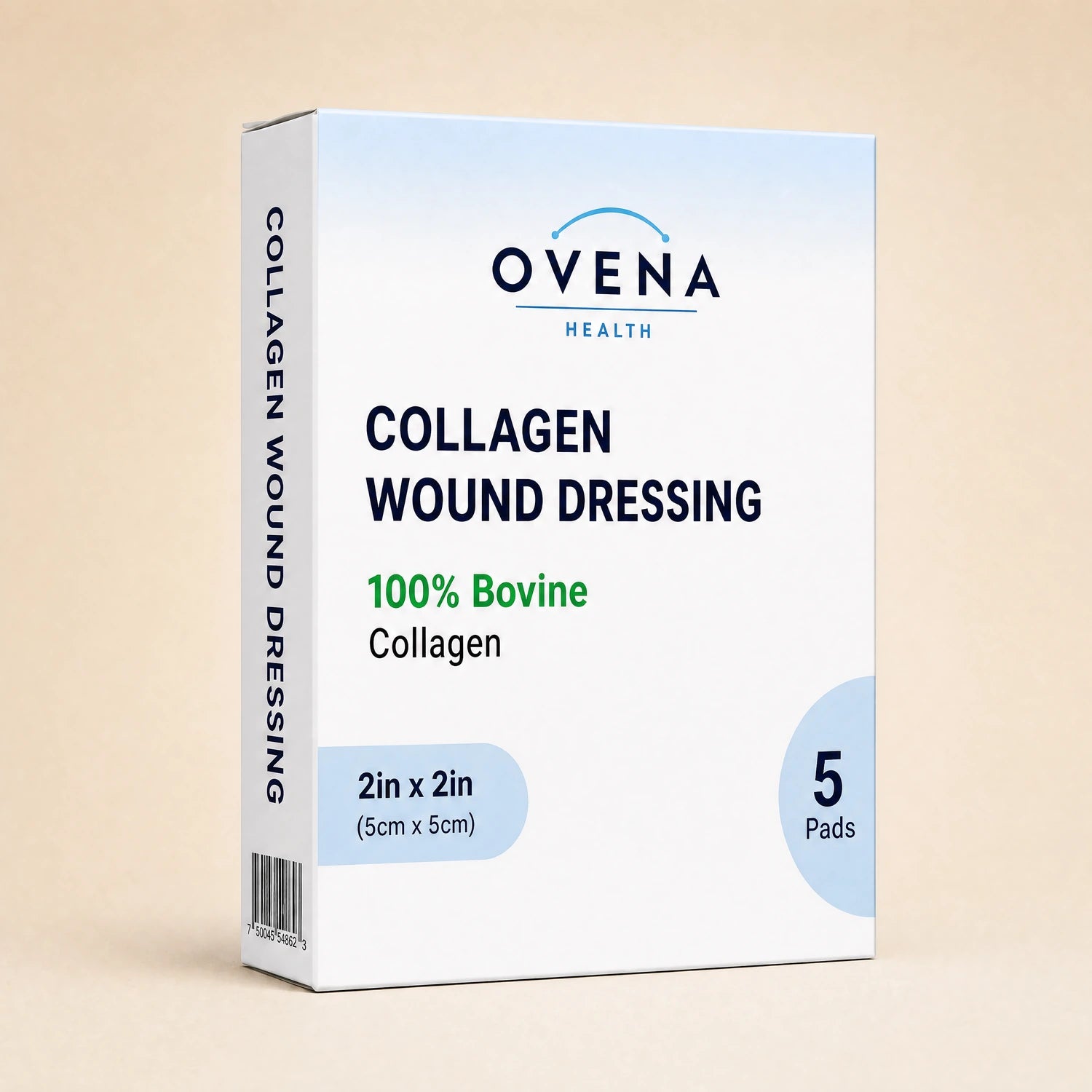
A collagen wound dressing is a sterile sheet (or powder) of purified Type I bovine collagen, the same protein that makes up about 80% of your skin's structural scaffold. When you put it on a wound bed, two things happen:
- The collagen binds matrix metalloproteinases (MMPs). MMPs are enzymes that break down old collagen as part of normal healing. In chronic wounds, MMP levels stay sky-high and start breaking down the new collagen the body is trying to lay down. Sacrificial collagen in the dressing soaks up that enzyme load, letting the patient's own tissue rebuild. See our MMP explainer for the full mechanism.
- It provides a scaffold for new tissue. New fibroblasts and capillaries need a structure to grow into. Collagen gives them one.
The collagen is gradually absorbed by the body as the wound heals, you don't peel it off.
Hydrocolloid, the passive moist environment
A hydrocolloid dressing is a flexible patch with a gel-forming layer (carboxymethylcellulose plus pectin and gelatin, sandwiched in a waterproof film). When you put it on a wound, it does three things:
- Absorbs exudate. Wound fluid soaks into the gel layer, which slowly turns white as it fills.
- Maintains a moist healing environment. Modern wound care has known for 60+ years (since George Winter's 1962 work) that moist wounds heal about twice as fast as dry ones (1).
- Creates a barrier. The waterproof outer film keeps bacteria, water, and dirt out. You can shower with most hydrocolloids on.
Hydrocolloid is fundamentally passive, it doesn't do anything to the wound, it just creates the conditions for the wound to heal itself.
Side-by-side comparison
| Factor | Collagen | Hydrocolloid |
|---|---|---|
| Mechanism | Active, MMP binding + scaffold | Passive, moisture + barrier |
| Best for | Stalled chronic wounds, DFUs, pressure injuries stage 2–4, surgical wounds healing open, donor sites | Shallow partial-thickness wounds, blisters, minor abrasions, stage 1–2 pressure injuries, pimples |
| Avoid for | Active infection (treat first), dry necrotic wounds, third-degree burns | Active infection, heavy exudate, full-thickness wounds, diabetic foot ulcers (occlusion + immunity risk) |
| Exudate handling | Low to moderate (collagen absorbs some) | Low to moderate (depends on thickness) |
| Wear time | 1–3 days between changes | 3–7 days between changes |
| Removal | Gradually absorbed, no peeling | Peeled off when saturated |
| Cost per use | Higher (manufacturing + 510(k)) | Lower |
| Regulatory | FDA 510(k) Class II medical device | Most Class I; some Class II (depends on claims) |
| FSA/HSA | Yes (HCPCS A6021, A6022, A6010) | Often yes; depends on plan |
When to pick collagen
Pick collagen when the wound is stalled, open for more than 4 weeks, or not closing despite consistent care, or when you're working on a high-risk wound that needs every advantage.
- Diabetic foot ulcers (DFUs). The MMP load in chronic DFUs is extreme; collagen is a clinical mainstay (2). Always under wound clinician care given amputation risk.
- Pressure injuries, stages 2–4. The 4×4 sheet or powder form is the workhorse for sacral and heel injuries.
- Surgical wounds healing by secondary intention (left open to fill in from the bottom up).
- Post-Mohs reconstruction sites.
- Skin graft donor sites.
- Venous leg ulcers, in combination with compression therapy.
- Partial-thickness burns (second-degree, under clinician supervision).
When to pick hydrocolloid
Pick hydrocolloid when the wound is shallow, clean, and just needs the right environment to heal itself.
- Blisters (heel blisters from new shoes or compression socks, friction blisters from hiking).
- Minor abrasions (scrapes, rug burns).
- Stage 1 pressure injuries (intact skin that's red and tender) and early stage 2.
- Surgical incisions healing by primary intention (closed with sutures or glue) for added protection.
- Drain sites after surgical drains come out.
- Pimples and cystic acne. Same material, way better value in a roll than as pre-cut "dots."
- Donor sites with low exudate.
When neither is right
Sometimes you need a different dressing entirely:
- Heavy exudate, use foam (Mepilex, Allevyn) or alginate (Kaltostat) instead.
- Dry necrotic eschar that needs debridement, use hydrogel to rehydrate, or get surgical debridement.
- Active infection, treat the infection first with topical (silver, iodine) or systemic antimicrobials, then return to collagen or hydrocolloid.
- Third-degree burns, emergency burn center care. Don't try home wound care.
- Tunneling or undermining wounds, collagen powder may fill irregular spaces better than a sheet; severe cases need clinician assessment.
A 60-second decision tree
- Is the wound actively infected? (Foul odor, hot red surrounding skin, fever) → Treat infection first. See a clinician.
- Is it deeper than your skin or visible bone/tendon/fat? → See a clinician before any home dressing.
- Has the wound been open more than 4 weeks? → Collagen. It's likely stuck and needs the MMP binding to restart.
- Is it a shallow blister, minor abrasion, drain site, or pimple? → Hydrocolloid. Cheaper, longer wear, easier.
- Is it a stage 2+ pressure injury, DFU, post-Mohs, or surgical wound healing open? → Collagen.
- Otherwise unsure? → Hydrocolloid is the lower-stakes default for a shallow, clean wound. Re-evaluate at one week.
Both, in one cart
Ovena makes both, FDA 510(k)-cleared collagen for stalled wounds, and clinical-grade hydrocolloid in a 5-foot cut-to-size roll. Free shipping over $75.
Shop collagen → Shop hydrocolloid →Frequently asked questions
Can I use collagen and hydrocolloid on the same wound?
Which one is better for diabetic foot ulcers?
Which one is better for pimples and cystic acne?
Which one is cheaper per use?
Are both FSA/HSA eligible?
Sources
- Winter GD. Formation of the scab and the rate of epithelialization of superficial wounds in the skin of the young domestic pig. Nature. 1962;193:293-294.
- Edwards JV, Yager DR, Cohen IK, et al. Modified cotton gauze dressings that selectively absorb neutrophil elastase activity in solution. Wound Repair Regen. 2001;9(1):50-58.
- WOCN Society. Guideline for the Prevention and Management of Pressure Ulcers (Injuries). 2022.
- EWMA Position Document: Identifying criteria for wound infection. European Wound Management Association, 2024 update.