Collagen wound dressings: a clinical guide for caregivers and patients
If you're caring for a chronic wound, a diabetic foot ulcer, a pressure injury, or a slow-healing surgical incision, you've likely heard collagen dressings recommended. This clinician-reviewed guide explains what they are, how they help stalled wounds heal, when to use them, and how to apply one step by step.
 Reviewed byDr. David Chahine, MD
In this guide
What is a collagen wound dressing?
Collagen is the most abundant protein in the body, it's the scaffold that holds skin, tendons, bones, and blood vessels together. A collagen wound dressing is exactly what it sounds like: a sterile, FDA-cleared sheet (or powder) made primarily of purified type I collagen, applied directly to a wound bed.
Unlike a Band-Aid, which just covers a wound and waits, a collagen dressing actively participates in healing. The collagen acts as a scaffold for new tissue to grow into, and it chemically binds inflammatory enzymes (called matrix metalloproteinases, or MMPs) that build up in chronic wounds and prevent healing. As the wound heals, the collagen is gradually absorbed by the body, you don't have to peel it off.
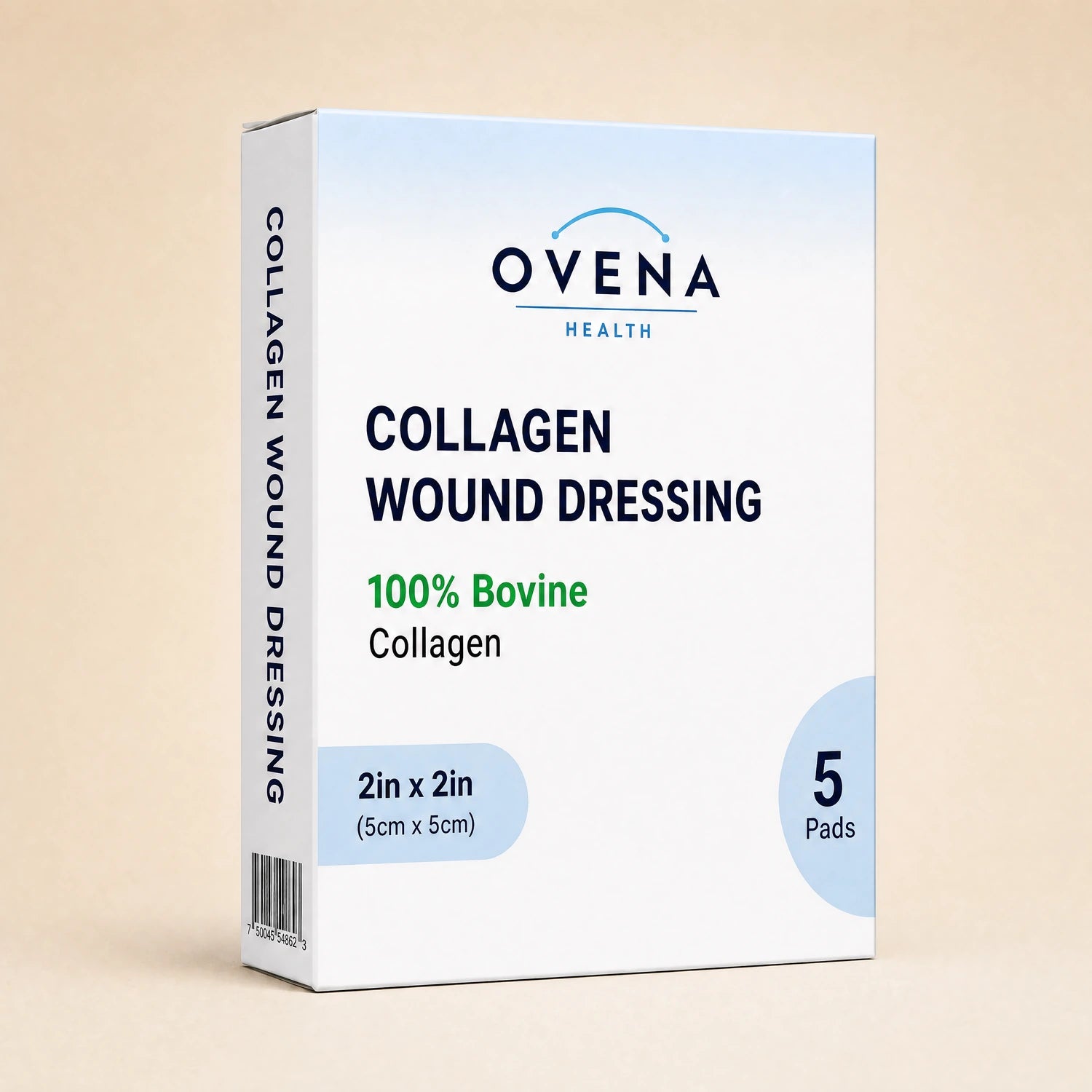
Ovena's collagen dressings are FDA 510(k)-cleared Class II medical devices, made from 100% type I bovine collagen, manufactured in the United States in an ISO 13485 facility.
How collagen wound dressings actually work
Chronic wounds, wounds open more than four weeks, get stuck. The body's normal healing cascade (inflammation, tissue proliferation, remodeling) stalls in the inflammation phase. One reason is that the wound bed becomes saturated with matrix metalloproteinases (MMPs), enzymes that break down the very collagen the body needs to lay down new tissue.
A collagen wound dressing does two things at once:
- Sacrificial substrate. The collagen in the dressing is digested by the MMPs preferentially, keeping the patient's own tissue intact while the inflammatory environment calms down.
- Scaffold for new tissue. The remaining collagen matrix gives new fibroblasts, capillaries, and granulation tissue a structure to attach to and grow through.
Collagen vs. hydrocolloid vs. foam: which to use when
| Dressing | Best for | Avoid for |
|---|---|---|
| Collagen | Stalled chronic wounds, DFUs, pressure injuries stages 2–4, surgical incisions, donor sites | Heavily infected wounds (until controlled), dry necrotic wounds, third-degree burns |
| Hydrocolloid | Shallow partial-thickness wounds, blisters, minor abrasions, low-exudate wounds | Infected wounds, full-thickness wounds, heavy exudate |
| Foam | Moderate-to-heavy exudate, pressure relief, leg ulcers | Dry wounds (will desiccate the bed) |
How to apply a collagen dressing in 6 steps
- Wash your hands. Use soap and water, then put on clean (not sterile) gloves.
- Cleanse the wound. Irrigate with normal saline or a wound cleanser. Don't use hydrogen peroxide or alcohol, they damage healing tissue.
- Pat the surrounding skin dry. The wound bed itself can stay slightly moist.
- Cut the dressing to size. Leave about a quarter-inch border beyond the wound edge. If irregular, use powder or layer sheets.
- Apply collagen directly to the wound bed. Smooth it down so it makes full contact.
- Cover with a secondary dressing. A non-adherent pad, gauze, or foam, then secure with tape or a wrap. Change every 1–3 days.
Collagen for diabetic foot ulcers
Diabetic foot ulcers (DFUs) are the leading cause of non-traumatic lower-limb amputation in the United States. The MMP load in a chronic DFU is extremely high, collagen dressings are a clinical mainstay because they help reduce the destructive load, give granulation tissue a scaffold, and keep the wound bed moist enough to heal without macerating the surrounding skin.
Important: diabetic foot wounds carry serious infection and amputation risk. Use Ovena collagen as part of the care regimen your wound care clinician, podiatrist, or endocrinologist recommends, not as a replacement for clinical care.
Shop Ovena collagen dressings →
Collagen for pressure injuries
Indicated for stage 2, 3, and 4 pressure injuries. For deeper wounds with tunneling or undermining, the powder form fills irregular cavities better than a flat sheet. For larger sacral injuries the 7×7 size is the most efficient choice. Pressure relief through repositioning, specialty mattresses, and heel offloading is the other half of the answer.
Collagen for surgical wounds and donor sites
Used on surgical incisions healing by secondary intention (left open to heal from the inside out), partial-thickness burns, skin graft donor sites, and post-Mohs reconstruction. The 2×2 size fits most biopsy and post-Mohs sites; the 4×4 covers most general surgical wounds.
FAQs about collagen wound care
How is Ovena collagen different from amino-acid skincare collagen?
Can I use collagen on a wound that's actively bleeding?
Is it vegetarian?
What if my wound is infected?
When to see a clinician
- The wound is producing thick, foul-smelling discharge
- The surrounding skin is hot, red, or rapidly spreading redness
- You develop a fever, chills, or feel generally unwell
- The wound is deep (you can see bone, tendon, or fat) or has a tunnel under the skin
- The wound hasn't shown any improvement after 2 weeks of consistent care
- You have diabetes, peripheral artery disease, or are immunocompromised