Hydrocolloid dressings: how a cut-to-size roll handles everything from blisters to surgical sites
Hydrocolloid is the moist-healing dressing you've likely already used as a blister or acne patch. This clinician-reviewed guide covers how it works, when to reach for it (and when not to), how to apply a cut-to-size roll, and how long to leave it on.
 Reviewed byDr. David Chahine, MD
In this guide
What is a hydrocolloid dressing?
A hydrocolloid dressing is a flexible, waterproof wound covering with an inner layer of gel-forming agents (typically pectin, gelatin, and carboxymethylcellulose) bonded to a skin-friendly adhesive and sealed under an outer film. It's the same technology behind the "blister bandages" and "acne patches" you've likely already used, just available as a clinical-grade, cut-to-size roll.
Unlike a dry gauze pad, hydrocolloid is an occlusive, moist-healing dressing: it seals the wound off from outside air and bacteria while keeping the wound bed moist, the environment modern wound care guidance generally favors over letting a wound dry out and scab over.
How hydrocolloid actually works
When the inner layer contacts wound fluid (exudate), the gel-forming particles absorb it and swell into a soft gel that sits over the wound. This gel maintains a moist, slightly acidic environment that supports the body's own repair cells, keeps new tissue from drying out, and cushions the area from friction.
Because the dressing is occlusive, it also holds the wound at body temperature and blocks external contaminants. As it absorbs fluid you'll often see a raised, opaque "bubble" form over the wound, that's normal and a sign it's working, not a sign of infection.
Cut-to-size roll vs. pre-cut patches
| Cut-to-size roll | Pre-cut patches | |
|---|---|---|
| Fit | Trim to the exact wound shape and size | Fixed shapes only |
| Cost per wound | Lower, you use only what you need | Higher, you pay per patch |
| Best for | Heels, knees, odd shapes, larger areas | Small round spots |
| Waste | Minimal | Often oversized for small wounds |
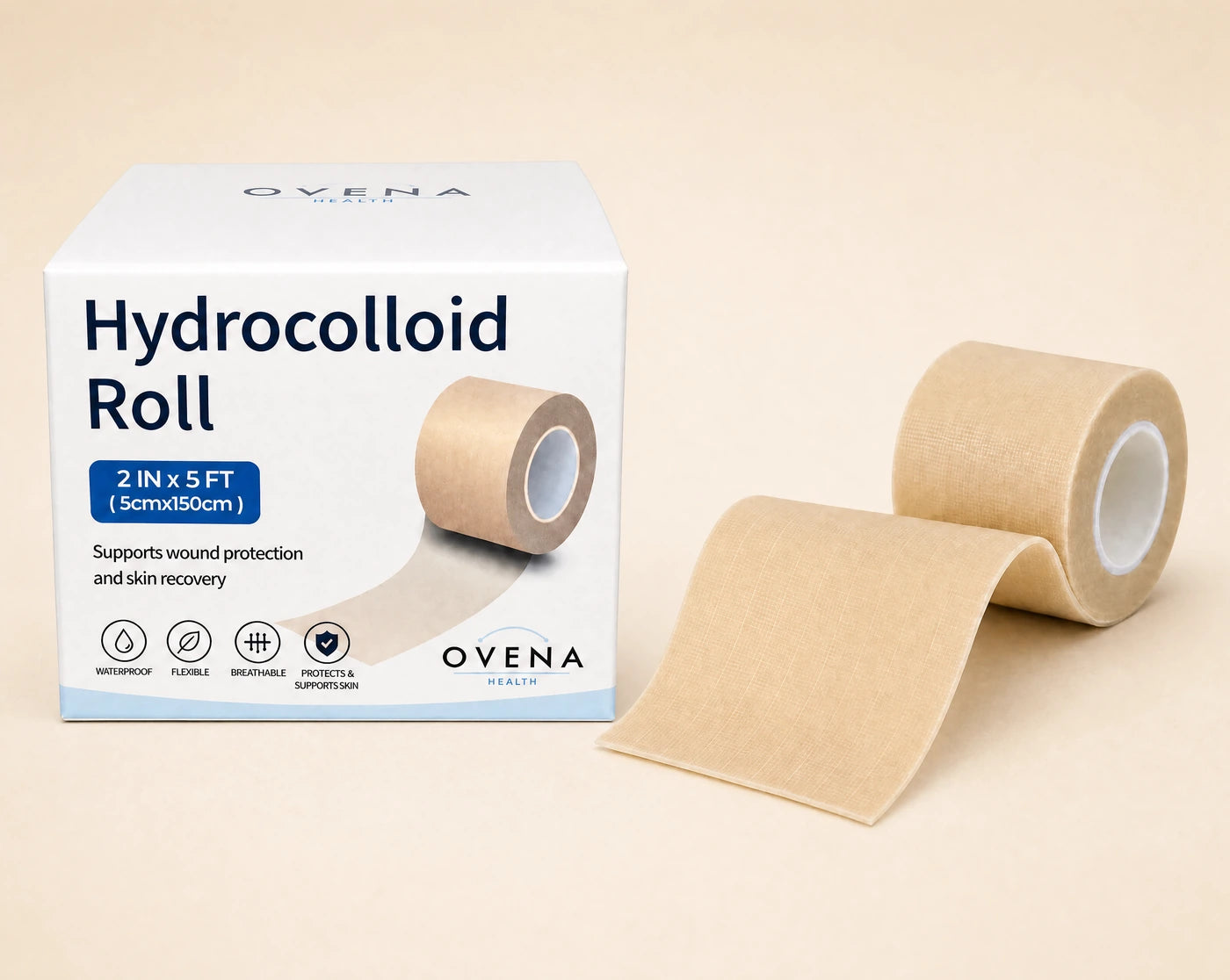
A 2 in x 5 ft or 2 in x 16 ft roll lets you cut a dressing for a fingertip or wrap a heel, all from one product. See Ovena's hydrocolloid roll →
When to use it (and when not to)
Good for: shallow, low-to-moderately draining wounds with clean edges, friction blisters, minor surgical or post-procedure sites, abrasions, shallow pressure areas (Stage 1-2), and minor everyday cuts you want to heal cleanly.
Not for: infected wounds, heavily draining wounds, deep or puncture wounds, third-degree burns, or wounds with exposed tendon or bone. Diabetic foot ulcers and any non-healing wound should be managed with a clinician.
How to apply a hydrocolloid dressing
- Clean and fully dry the skin around the wound. Hydrocolloid won't stick to damp or oily skin.
- Cut a piece with at least a half-inch (1 cm) margin of healthy skin beyond the wound on all sides.
- Round the corners with your scissors, rounded edges lift far less than square ones.
- Warm it in your hands for a few seconds, then press it on from the center outward.
- Hold for about 30 seconds, body heat activates the adhesive for a better seal.
Common uses
Friction blisters
Cushions the blister, relieves pressure, and lets it heal without bursting or scabbing. A favorite for hikers, runners, and new-shoe break-in.
Minor surgical and post-procedure sites
Often used over shallow excisions and minor Mohs sites once a clinician confirms the wound is clean and appropriate, follow your provider's instructions.
Acne and surface blemishes
The same occlusive action draws fluid from a surface blemish and protects it from picking. Use on un-popped, non-cystic spots only.
Shallow abrasions and scrapes
Keeps road-rash or a scrape moist so it heals with less scarring than an open scab.
How long to leave it on
Leave a hydrocolloid dressing in place until the gel "bubble" spreads close to the edges, or fluid starts to leak, typically 2 to 4 days. Changing it too often interrupts the moist-healing environment and wastes dressing.
- Change sooner if it leaks, lifts at the edges, or you suspect infection (increasing pain, redness, warmth, or odor).
- You can shower with it on, the outer film is waterproof. Pat dry afterward.
- Don't re-use a dressing once it's been removed.