
Most compression socks won't tell you the number. The real ones print it on the box.
"Compression" on its own is a marketing word. The number is the spec. Ovena socks are 20–30 mmHg medical-grade graduated compression — firmest at the ankle, easing up the calf — and the number is printed right on the box, so you know exactly what your legs are getting.
The spec is on the box: 20–30 mmHg, graduated. Every pair also comes with the pH-balanced cleanser free — a $3.99 value, gentle on elastic fibers.
- 20–30 mmHg graduated — firmest at the ankle, easing up the calf
- Helps improve circulation, reduce swelling, and relieve tired, achy legs
- Moisture-wicking knit — reinforced heel and toe, unisex S–XL

"Most socks just say 'compression.' The real ones come down to the number — 20 to 30 mmHg is the level I recommend for firm, all-day support on long shifts, travel days, and standing work — and it's printed on every Ovena box. Check the number before you buy."
Physician-led brand · The number is the spec.Fluid pooling, or supported upward flow.
Gravity pulls fluid down; by the end of a long day it can pool around the ankles. Graduated compression is snug at the ankle and eases up the calf, supporting flow back up the leg — which helps improve circulation, reduce swelling, and relieve tired, achy legs. Worn as directed.
Three things the number tells you.
One line of print does more work than a page of adjectives.
The level
20–30 mmHg is a firm, daily-wear support level — a real spec, not a softness rating.
The direction
Graduated means the pressure has a gradient — firmest at the ankle, easing up the calf.
The accountability
A brand that prints the number is making a claim you can hold it to. Vague listings can't be checked.
On the box. In the sock.
Compression level measured at the ankle and graduated up the calf. Wear as directed.
Reasons to buy with confidence.
Physician-led, with the spec printed on the box, and built for daily wear — here's what stands behind every pair.
What the number feels like, day one.
A 20–30 mmHg sock is a firmer sock — here's the honest rhythm of it.
Check the box
20–30 mmHg, printed where you can see it — the spec you chose on purpose.
Feel it at the ankle
A firm sock, snug where it should be. You'll feel it the first time — that's the level working, not a sizing mistake.
Forget it by mid-morning
Graduated support settles in for the shift, the flight, or the long day on your feet.
Wash it right
The included pH-balanced cleanser is gentle on elastic fibers. Cool wash, no bleach or fabric softener, air dry.
Questions, answered.
What does 20–30 mmHg actually mean?
Why does graduated matter?
Why does it matter that the number is on the box?
Is a higher number always better?
They feel tight the first time — is that normal?
How do I pick my size?
What if the size is wrong?
Are they FSA/HSA eligible?
One pair, or the rotation.
All sizes are the same price — choose your size in the offer above. Every pair comes with a free pH-balanced cleanser. Ships from the US.
Low-risk to try.
Not ready? Take the compression numbers guide.
What 15–20, 20–30, and 30–40 mmHg mean, how to read a box like a clinician, and how to make your pair last.
One email with the guide. Unsubscribe anytime.
Check the number. Then check ours.
20–30 mmHg medical-grade graduated compression — printed on the box, worn by the physician who leads the brand.
Get my pair — $24.99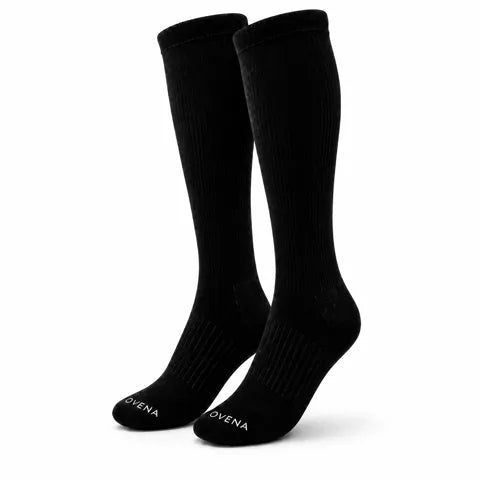
- Choosing a selection results in a full page refresh.
- Opens in a new window.
We use cookies to run our store, remember your cart, and understand how the site is used. Read our Privacy Policy.